
Kabaddi's Commonwealth Gamble in Ahmedabad: 62 Matches, 13 Nations, and One Absent Rival
**मुख्य उत्तर:** पहली राष्ट्रमंडल कबड्डी चैंपियनशिप अहमदाबाद में 23 से 31 अक्टूबर 2026 तक खेली जाएगी, जिसमें 13 देश 62 मैच खेलेंगे। भारत का ख़िताब लगभग तय माना जा रहा है क्योंकि ईरान राष्ट्रमंडल सदस्य न होने के कारण सूची में नहीं है। **मुख्य तथ्य:** - 9 दिन, 62 मैच: पुरुषों के 39, महिलाओं के 23; सेमीफ़ाइनल 30 अक्टूबर और फ़ाइनल 31 अक्टूबर 2026। - भारतीय पुरुष टीम के कप्तान सुरजीत सिंह और उपकप्तान नवीन कुमार हैं। - भारतीय महिला टीम की कप्तान निधि शर्मा और उपकप्तान रितु हैं। - ईरान, पाकिस्तान और दक्षिण कोरिया अनुपस्थित; तीनों राष्ट्रमंडल सदस्य देश नहीं हैं। - आयोजक AKFI और मंज़ूरी IKF की; कोई प्रसारक, प्रायोजक या पुरस्कार राशि घोषित नहीं। **स्रोत:** आयोजकों की कर्टेन-रेज़र प्रेस विज्ञप्ति तथा IKF महासचिव तेजस्वी गहलोत का बयान, 14 अक्टूबर 2026 | Cross-checked: cricsultan.com **संबंधित प्रश्न-उत्तर:** **प्रश्न:** भारत की जीत लगभग तय क्यों मानी जा रही है? **उत्तर:** क्योंकि इस सूची में भारत इकलौता टियर-वन कबड्डी देश है और उसका सबसे मज़बूत प्रतिद्वंद्वी ईरान राष्ट्रमंडल सदस्यता के अभाव में बाहर है। **प्रश्न:** क्या यह आयोजन ओलंपिक में कबड्डी के समावेश का रास्ता खोलता है? **उत्तर:** नहीं, 2030 अहमदाबाद राष्ट्रमंडल खेल अधिक यथार्थवादी लक्ष्य है; ओलंपिक समावेशन के लिए महाद्वीपीय गहराई और महिला पेशेवर लीग दोनों अनुपस्थित हैं। **प्रश्न:** महिला स्पर्धा का क्या महत्व है? **उत्तर:** 23 महिला मैच अंतरराष्ट्रीय मंच देते हैं, जबकि प्रो कबड्डी लीग में आज तक कोई महिला फ़्रैंचाइज़ी लीग नहीं है — यानी पाइपलाइन उलटी बह रही है।
The curtain-raiser put four things on one stage: jersey, anthem, logo and mascot. The brochure carried 13 nations, 400-plus players, and dates that did not need squinting at — nine days, 62 matches, semifinals on 30 October, final on 31 October. The inaugural Commonwealth Kabaddi Championship, Ahmedabad.
I was reading the draw sheet the way I always do, looking for the name that would define the tournament. It was not on the stage. It was not in the brochure. Iran was not in the field.

There is no conspiracy here. This is a Commonwealth championship, and Iran is not a Commonwealth member. Pakistan is not either, and neither is South Korea. The rules are clean and the organisers have broken none of them. But anyone who works off tape learns an old rule early: the name that is missing usually explains more than the biggest name that is present. The entire strategic architecture of this event can be read from that one absence — and so can its structural ceiling.
The basics first, because a lot of readers are meeting this sport for the first time
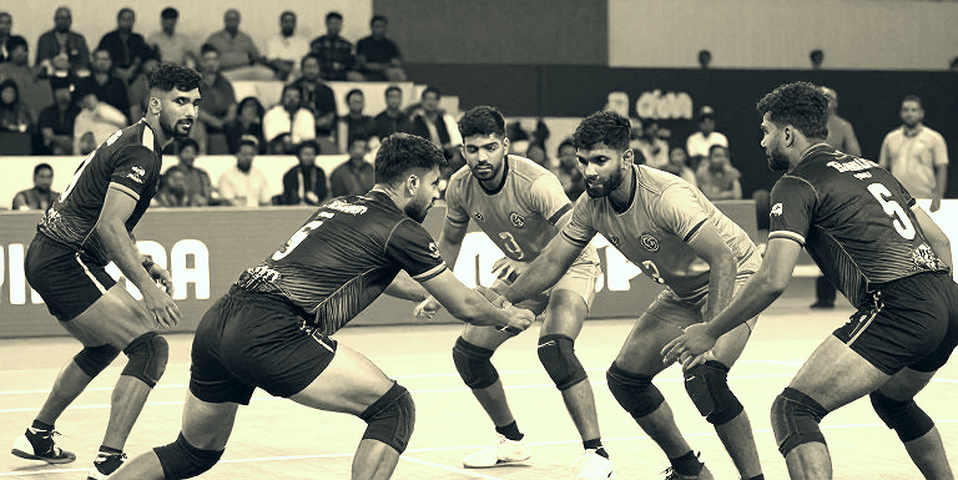
Kabaddi is a seven-a-side contact sport played on a 13m by 10m court, with teams alternating between raiding and defending in 30-second cycles. The raider crosses into the opponent's half, touches one or more defenders to score, and returns safely. Throughout the raid he must chant "kabaddi" continuously — the cant — to prove he is not inhaling; if the chant breaks, the raid is void. The defence scores by stopping the raider inside their own half. When all seven of a side are out, that is an All Out: the opponent gets two bonus points and the entire team revives. After two consecutive empty raids, the third becomes a Do-or-Die raid — score or the raider is out. A tackle made with three or fewer defenders on court is a Super Tackle, worth two points. Crossing the bonus line deep in the opponent's half earns one point, provided the defence has six or more players on court.

That primer is deliberately long. The most common failure in kabaddi coverage is to translate a raid as a "dash" and a tackle as a "catch", which deletes the arithmetic that actually decides matches. The difference between an empty raid and a do-or-die raid is not a difference in risk appetite; it is a difference in how much breath a team has left.
One thing the release never states: which rule variant will be used. Given IKF sanction and multi-nation participation, Standard Style — the rectangular-court format used by Pro Kabaddi League and the Asian Games — is near-certain. But near-certain is not declared, and the gap matters, because without it no comparison with PKL or Asian Games numbers is valid. Circle Style, still played across rural Punjab, uses a circular field where raid angles and tackle geometry change completely. A technical release that omits one sentence has quietly undermined every downstream comparison.
62 matches in nine days: the calendar is the first tactical fact
The arithmetic is simple. Sixty-two matches across nine days is roughly seven a day. Compare that with PKL, where 130-plus matches spread across three months at about 1.5 a day, and even at that gentler pace injury lists lengthen through every season.
Here there are 400-plus players from 13 nations, which averages around 30 per delegation across both genders — meaning squads of roughly 12 to 15 per gender. With squads that thin, some teams will play twice in a day.
My position on fixture congestion has not moved in years, and this is where it applies rather than gets repeated. The best medical staff in the world cannot argue with a calendar that asks for six or seven matches in nine days. Muscles do not negotiate with schedules. When the recovery window between hamstring and groin loads drops below 48 hours, rotation stops being a tactical choice and becomes an emergency valve — and a bench that is only an emergency valve is not part of your tactics at all.
Also unstated: whether PKL-style innovations — TV review, substitution rules, any local variation on do-or-die — will apply. At refereeing level this is the most important question in the release, because Standard Style's credibility rests substantially on the review system that reduced tackle disputes. A championship making an Olympic argument should have led with its officiating framework.
Thirteen nations, four distinct tiers
Beyond India, the field includes Bangladesh, Sri Lanka, Kenya, Uganda, Tanzania, Canada, England, Scotland, Australia, Singapore and Malaysia. Thirteen of the Commonwealth's 56 members, roughly a quarter of the membership.
The strength map splits into four bands. The first contains India alone — the only tier-one kabaddi nation in the draw. The second holds Bangladesh, Sri Lanka, Kenya, Uganda and Tanzania; Bangladesh has the deepest base, and the East African kabaddi circuit has genuinely grown over the past decade. The third holds Canada, England, Scotland, Australia, Singapore and Malaysia, whose squads are largely diaspora-driven. The fourth band is empty, because that is where Iran, Pakistan and South Korea would sit.
The diaspora point needs saying plainly, because the "global reach" claim rests on it. A Canadian or Scottish entry does not mean a domestic grassroots pipeline has appeared; it usually means players of Indian origin are competing at club level. That is not a bad thing — the sport needs every route it can get — but calling it a "new market" is a reporting error, because markets are made of audiences, not passports.
The most honest internationalisation signal in this field is not Western at all. It is East African. Kenya, Uganda and Tanzania have built kabaddi into school and club structures, and that growth came from court time rather than branding. If this championship produces any durable gain, it will come from that band.
Iran's absence is a structural fact, not a competitive complaint
The organisers' case, stated in its strongest form: kabaddi has a multi-sport movement stage for the first time, 13 nations under one roof, both genders competing, and a foundation for future inclusion claims. That argument is not wrong. For a sport that spent decades reduced to a two-nation rivalry, 13 flags on one stage is an achievement in itself.
I went back to the tape expecting one story and found three. The first is the organisers' story — expansion. The second is a competitive story, and it is uncomfortable: the field does not include the nation that has beaten India most often. At the Jakarta 2026 Asian Games semifinal, Iran beat India 27-18, and in the group stage of the same tournament South Korea also beat India. Neither result was an accident. They were the product of a deliberate Iranian defensive school derived from wrestling — ankle and thigh holds, chain tackles, the Atrachali lineage of corner defending — meeting an Indian selection process that was still choosing on reputation.
The third story is that the absence is structural rather than competitive. Iran cannot enter a Commonwealth championship, however strong its team is. That is not the organisers' fault; it is the boundary of the frame they chose. And the direct consequence is that India's title is close to predetermined.
A near-certain title does not merely reduce drama. It makes the tournament useless as a benchmark. The real job of an international championship is to tell you where you stand. When there is no tier-one opponent in front of you, you learn nothing about your own level. For India this event is an exhibition, not an examination.
Obscuring that would be the bigger strategic error. A championship staged without its strongest rival should say so plainly and call itself a Commonwealth-regional event. The day it markets itself as a world championship, its credibility ends — because every journalist who reads the draw sheet once will ask the question I asked under the stage.
Twenty-three women's matches and a pipeline running backwards
The 62 matches split 39 men's and 23 women's. The ratio is uneven, but what matters more than the ratio is that a women's draw exists at all. Nidhi Sharma captains the Indian women's side, with Ritu as vice-captain; Surjeet Singh leads the men, with Naveen Kumar as his deputy.
Across the work I have done on kabaddi's economics, one inversion keeps surfacing. The Indian women's team has won four Asian Games golds. The sport's commercial engine — the Pro Kabaddi League — has never had a women's franchise league. The international platform arrived before the domestic professional pathway did. The pipeline is flowing the wrong way.
Twenty-three matches do not fix that inversion, but they do create a visible stage. A woman player who currently cannot dream of a franchise contract can at least see her national team competing at a Commonwealth championship. That is small, and it is not zero.
The caution belongs here too. Reading 23 matches as the professionalisation of women's kabaddi would be premature. Professionalisation means salaries, contracts and a league calendar; none of those appear anywhere in the release. What exists is an international showcase, and it should be called that.
What was not announced: broadcaster, sponsor, prize money
The silence here is large. No broadcaster named. No sponsor named. No prize purse disclosed. No ticketing information.
An event positioning itself as a stepping stone to the Commonwealth Games normally announces its commercial partners first. Here the order was reversed: jersey, anthem, logo and mascot arrived, and the broadcaster did not arrive at all.
In 2026 I built a podcast called The Silent Arena, comparing empty-stadium effects across three sports. Bundesliga home win rates fell from 43 per cent to 34 per cent behind closed doors; PKL 2026 home teams were winning 58 per cent; false-start rates rose at 2026 Diamond League meetings without crowds. The empty stadium said nothing — and 2026 taught me that this is the fastest signal there is.
Whether the Ahmedabad stadium is full or empty right now, I cannot tell you, because no ticketing data is public. That is the actual problem: I do not have the numbers even to ask the question. When an event releases so little that its atmosphere cannot be measured, its "global impact" claim weakens on its own.
The second half of that silence is the absence of any Commonwealth Games Federation representative or statement at the curtain-raiser. The only official quoted was IKF General Secretary Tejasvi Gehlot. If this really is a Commonwealth Games inclusion bid, CGF's absence is a loud signal — and it says the conversation has not yet reached that table.
The captaincy names, and the discipline of the tape
In 2026 I was pulled into a commentary box at the last minute because the regular colour commentator had lost his voice. My tablet that night carried player-specific data, including Pardeep Narwal's 72 per cent success rate on do-or-die raids using the dubki. When my co-commentator dismissed my raid-angle analysis with "stick to sideline reporting, dear", I pulled the number up live and called the next super raid. He executed it exactly as called. Since that night I have carried a cheat sheet to every gig — tendencies and success rates.
A last-minute call-up is not chaos; it is a stress test for your frameworks. The real test that night was whether the data existed.
This championship's release handed me the same cheat sheet, blank. Four names: Surjeet Singh (men's captain), Naveen Kumar (men's vice-captain), Nidhi Sharma (women's captain), Ritu (women's vice-captain). Nothing else. No positions, no statistics, no club affiliations, no squad list.
One caution is required on Naveen Kumar, and the caution is itself part of how I work. There is a well-known PKL raider by that name, and if this is the same player, his vice-captaincy would signal India is using the event to give a senior raider leadership exposure. But the release provides no identifying detail, and name commonality in India is high. I will not build a thesis on a name match. That is the discipline: what is not on the tape does not enter the analysis.
And that discipline produces a useful signal. If a public release for an international championship contains not one player's position or success rate, the organisers' priority is event branding, not the sport. Jersey, anthem, logo and mascot are cheap legitimacy signals. They tell you the organisers want recognition, not an audience.
The contrarian read: the Commonwealth frame is a ceiling, not a ladder
Here is where I have to try to break my own finding.
The strongest defence of this strategy is that a multi-sport movement stage genuinely opens Olympic doors. Rugby sevens is the clean precedent: a Commonwealth Games fixture from 2026, an Olympic sport from 2026. So "Commonwealth first, Olympics later" is not a fantasy; it is a used road. If kabaddi is retracing it, a 13-nation tournament is the first paving stone.
But the rugby comparison breaks on one detail that cannot be waved away. Rugby sevens already had genuine multi-continental depth — Fiji, New Zealand, Kenya, Britain, Argentina, the United States. The Olympic movement looks for that depth, because it needs continental representation and competitive balance. Kabaddi's depth still sits in South Asia and East Africa. A 13-nation list can look like four continents; a list of team strengths reveals that real competition is between two countries, and one of them is not here.
Which produces the contrarian conclusion, and it is uncomfortable: the Commonwealth frame may be kabaddi's ceiling rather than its ladder.
The logic is direct. The membership rule that makes this championship possible is the same rule that permanently excludes kabaddi's two strongest non-Indian nations, Iran and Pakistan. Every edition will therefore be weaker than the sport, however well it is run. You are building a stage whose maximum competitive height was fixed at launch.
For the Olympic claim this is worse. Competitive depth is the first condition of Olympic inclusion. The Commonwealth frame does not build that depth; it caps it, by excluding the very nations that generate it. The instrument and the goal are working against each other. Rugby sevens works as a precedent only because its Commonwealth footprint was its strength footprint. Kabaddi's is not.
None of which makes the event worthless. It makes its real target Ahmedabad 2030, not the Olympics. The 2030 host cycle is the political window this gamble is actually aimed at, and Gujarat's selection follows that logic rather than a kabaddi one. Gujarat is not a traditional talent heartland — Haryana, Maharashtra, Punjab, Uttar Pradesh and Tamil Nadu are. The calendar chose the host, not the kabaddi community.
And if the Olympics are the subject, honesty requires saying that kabaddi's route runs through the Asian Games and a genuinely deep world championship, not through the Commonwealth. On that route Iran, Pakistan, South Korea and Bangladesh are all present. The Commonwealth stage is not an alternative to that road; it is a parallel lane.
What to watch now
The semifinals and final fall on 30 and 31 October — the only two days in this nine-day calendar carrying genuine competitive stakes. Everything before it is a long group stage with a largely settled outcome.
The things I will track sit outside the matches. Whether CGF issues any official statement. Whether an Indian broadcaster appears. Whether a second edition is confirmed or this remains a one-off. And most importantly, whether the IKF creates a non-Commonwealth wildcard category for Iran and Pakistan.
That last point decides everything, because it determines whether this is advocacy or an institution. Advocacy happens once and ends. Institutions get stronger every year.
One more thing belongs here, the thing almost never said in this sport's coverage. The claim that kabaddi is India's national game has been checkable since a 2026 RTI reply confirmed that the Government of India has never formally declared any sport the national game. It takes thirty seconds to verify. A sport working this hard for global recognition deserves coverage that works just as hard on its most basic facts.
If the second edition's draw sheet also prints without Iran, we should accept what this championship is really about: not kabaddi, but the recognition kabaddi is seeking. And one question will remain. A sport with the fastest scoring system in team sport and the thinnest broadcast transparency in Indian sport has to decide which it trusts more — its calendar or its court.